
Uncategorized
Eve test post

TO COME: MORE PROCESS PHOTOGRAPHS, AND VIDEO ON THE CREATION OF EVE.
It was not long ago that my sculpture of Eve was installed at Generation Park. We never got to have a dedication because of the virus. Then, my client sent this email that came from the CEO of Apache Industries, who apparently is housed in the building where Eve is. It lightened my heart. There are so many stories behind this sculpture. Many are miraculous to me. One day I hope to share.
Hello All,
As we approach the Holiday weekend I cannot help but feel that regardless of creed, race or religion the celebrations of Easter, Passover, Ramadan etc… seem to take on a more elevated meaning in this moment. The Christian faith practices Lent, which importantly involves some form of personal sacrifice, self-denial and penance for the 6 weeks leading up to celebration of resurrection on Easter Sunday. In the Jewish faith Passover and the Seder celebrates the holy spirit “passing over” the marked doorposts of those who would otherwise be inflicted by the last of the 10 plagues preceding the Israelites escape from slavery. And in Islam, Ramadan (albeit a couple weeks away) is a month of fasting aimed at cleansing the soul and encouraging self-discipline, empathy for others less fortunate, generosity and compassion.
How fortuitous is it that we all find ourselves battling a pandemic (plague), while at the same time, we find ourselves making great personal sacrifice of the comforts, freedoms or indulgences that are typically available to all of us, and it is our reliance on our collective self-discipline and humanity to find a pathway to salvation? In this moment, when we all learn to do without in the face of adversity, I can’t help but feel re-centered on the things that matter most—my family, my friends and my colleagues.
Each day at the office, I look out the window onto Redemption Square (also a biblical reference). Installed in the middle of the square is a 15-foot tall statue of Eve. The curator told me that the statue is an image of Eve, later in life, head tilted towards the sky, arm and open hand raised high, reaching for the Heavens in search of redemption from God. To me, the image is an extraordinary symbol of perseverance, tenacity and hope.
However, every time I look at Eve, I also cannot help but visualize the statue taking motion and watching that outstretched open hand turn powerfully into raised, clenched fist—the universal representation of the underdog’s ascension, the warrior’s triumph or the champion’s demonstration of victory.
So on this holiday weekend let us all share in a moment of prayer or reflection with our families and our loved ones. Let us not take for granted the people in our lives that matter most.
And, also, let us all mark this weekend…let it be the inflection point…where our collective sacrifice, perseverance and tenacity starts to turn open hand into clenched fist.
I am always grateful for all of the Apache family!
We will triumph!
We are Apache!
Happy Easter!
MK
Michael J. Knigin
Chief Executive Officer
Apache Industrial services.
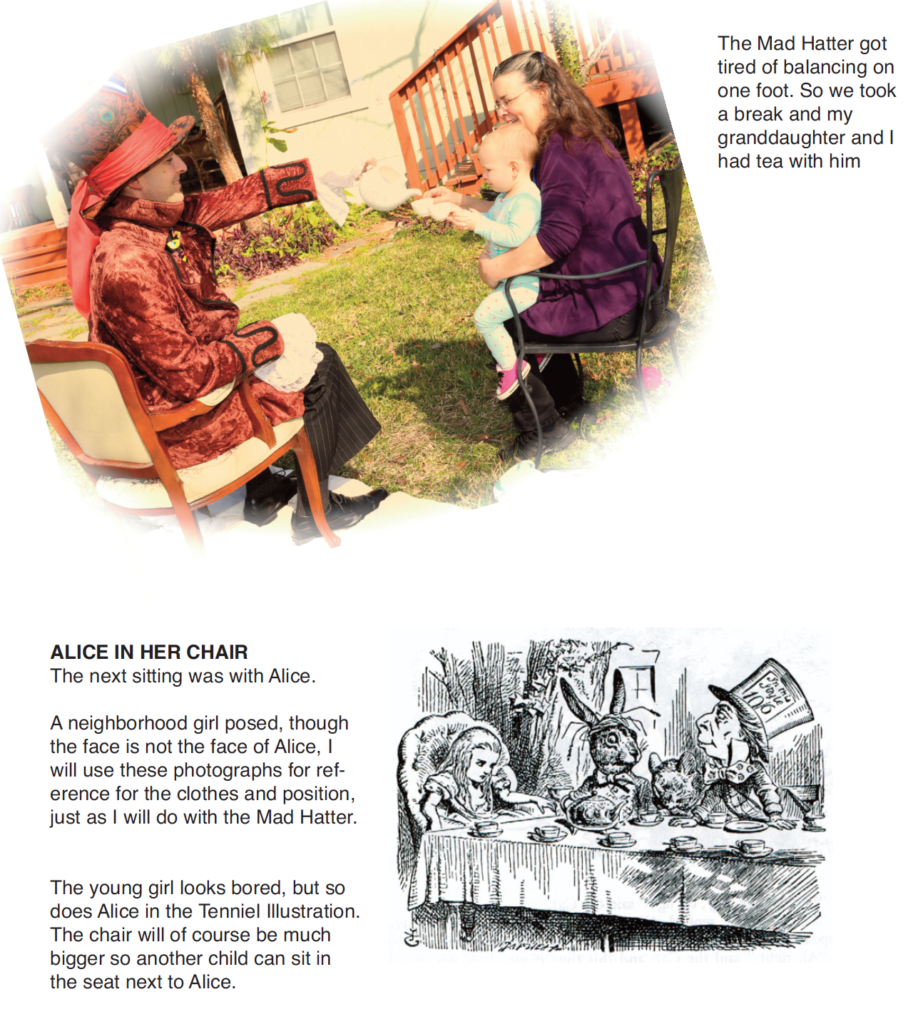
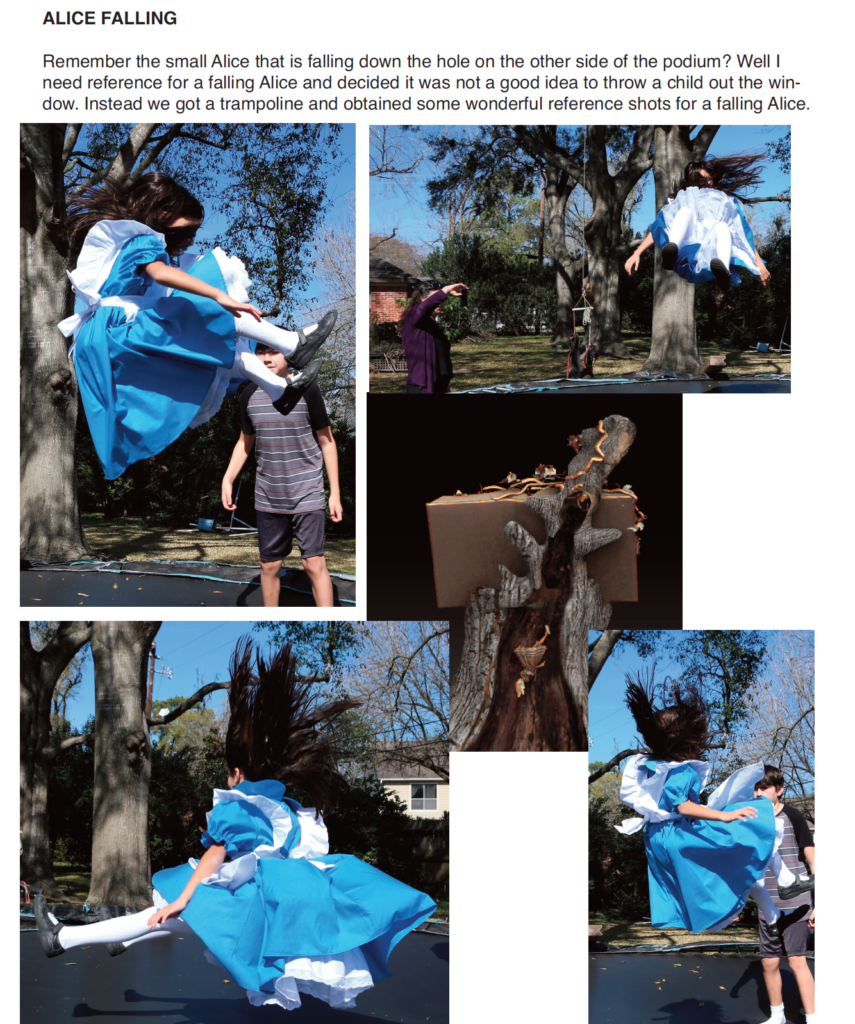
A Sitting For Mad Hatter’s Tea Party Cont.

You Could Lose Your Rights To All The Work You Have Ever Created
Created for Best of Artists and Artisans web site
By Bridgette Mongeon © 2008

Immediate action is needed concerning the
Senate Bill S. 2913 and House Bill H.R. 5889, the Orphan Works Acts of 2008.
America is known for the country that protects an individual’s rights. It is impossible for me to comprehend that my rights as an artist may soon drastically change, and that I could lose the rights to all the work that I have ever created. When I first heard about this, it was so unbelievable that I thought that it must be a prank. But, with further investigation I found it was not. In this article I will include a little about what I found and links with other articles for readers to peruse so that they can make their own informed decision. I am also setting up interviews with several people including Copyright lawyers, those in the writers unions, and even those in the American Federation of Television and Radio artists, to name a few. There is urgency in acting and spreading this information. For whatever reason, this is moving through congress quite quickly and will affect your rights and possibly your income as a creative person.
As I find more information and create these interviews, I will pass them on to the Editors at Best of Artists and Artisans sculpture blog to be posted at their discretion. I will also post all of the information that I find on my home page blog, located at http://www.creativesculpture.com/blog
COPYRIGHT LAW AS IT STANDS TODAY
First, a few basics about copyright law as it stands today. According to the copyright law of 1976, everything that you create is protected by copyright from the moment you create it, even if it is not registered. This is the way copyright is handled throughout the world. It was defined by the Berne convention, which is an international agreement concerning copyrights.
With the current Copyright law, you do need to register your work if you want to collect for statutory damages for infringement. If, however, your work is registered and you discover someone has stolen it and you file suit, statutory damages are punitive and can be quite severe for those infringing on someone’s rights. This very idea keeps many people honest about “taking” other people’s artwork.
“It is not what it appears to be, it is a Trojan horse… Under this orphan works legislation, nothing you do would be protected unless it is registered with these commercial registries… they are orphaning all unregistered work” Brad Holland
THE CHANGE IN LAWA radically proposed change to the US copyright law allows infringers to exploit the right of copyright holders with little or no penalty according to the Orphan Works Opposition Headquarters (OWOH). “Two bills currently on the “rocket docket” would let infringers “orphan” any copyrighted work whose owner the infringer failed to locate through a vaguely defined “reasonably diligent” search. The creative arts industry, including world-renowned artists, designers, photographers, manufacturers, and licensing businesses have united to oppose this legislation.”
The New Orphans Work Act declares that nothing you do would be protected unless you register it with a registry, placing a burden of diligence on the copyright owner. It must also be stated that even though these bills are moving quite fast through congress, registries do not, at this time, exist. These would be private registries where an artist would be responsible to register their art. In other words, every artist will have to pay to own their own work and each of their pieces will have to be registered, right down to the sketches in their sketchbook. If they are not and someone comes across your work and they search these directories and do not find it, then they can say that they performed a “reasonably diligent search.” They can use your work at no cost. As I comprehend the ramifications of this, the works that are presently copyrighted would also have to be reregistered. The cost of registering each piece of artwork, nevertheless the time that it would take to register each piece of artwork throughout an artists lifetime, makes this task impossible and prohibitively expensive.
It is interesting to note the following—It is a violation of the Berne Convention for the Protection of Literary and Artistic Works for any country to impose registration on a rights holder as a condition of protecting his copyright. See Article 5(2) “The enjoyment and the exercise of these rights shall not be subject to any formality (emphasis added).”, (From How the Orphan Works Bills Affect Visual Artists. Illustrators Partnership of American)
According to some of the interviews that I have listened to a creative person would also have to police their artwork, making sure that no one has taken it or it may be considered orphaned.” It is also said that you would have to reply to all inquiries on your artwork or it might be considered orphaned. All of this hardly leaves room for an artist to create.
OWOH states, “The new bills would severely “limit” financial penalties for infringing. Opponents charge this will encourage deliberate theft because statutory damages are the only tool the law gives copyright holders to prevent abuse– and they say it works. Penalties for infringement almost certainly deter rampant abuse by making it risky. But as medical illustrator Cynthia Turner notes ‘the new bills would protect infringers by denying artists damages, incurred court costs, attorneys’ fees and other expenses.'”
“Because these bills were planned behind closed doors, introduced with little warning and fast-tracked for imminent passage, a broad-based coalition of artists and trade associations say they have had little time to respond and generate public discussion. They say that a radical change in intellectual property law should not be rushed through Congress without public vetting. They are calling on Congress to slow down this legislation until it can be subjected to an open, informed and transparent public debate.”
Those in support of this bill are libraries and educators that claim that this bill is intended to give libraries and museums greater latitude to commercialize archived works. But, according to tp the OWOH, “critics charge the bills have been drafted so broadly they would permit any infringer to commercially exploit any copyrighted work, from professional art to family photos.” Those supporting the bill say that if artwork is worth something it should be registered. But if it is not worth something why would others want to take it?
Brad Holland of the Illustrators Partnership of America comments on the bill, ‘It is not what it appears to be, it is a Trojan horse… Under this orphan works legislation, nothing you do would be protected unless it is registered with these commercial registries… they are orphaning all unregistered work”
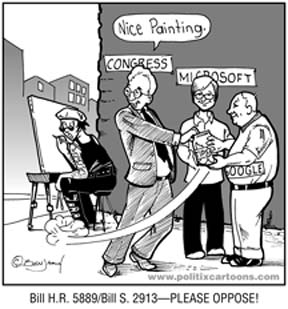
I encourage you to become familiar with the bill and take action accordingly. Your rights may be fading away without you even knowing it. If you would like to have your voice heard, The Illustrators Partnership of America has made it quite easy to take action. You can go to the web site and send an email, but faxes and letters are also encouraged. Please keep coming back for further information on this subject and send a link to this blog to other creative people that you know.
OTHER RESOURCES
Don’t take my word for it. You must decide how important this is to you. Here are some places to start.
- A wonderful resource of articles about this bill put out by the Illustrators’ Partnership
For comprehensive bill descriptions that describe the impact on visual artists:
House Bill http://capwiz.com/illustratorspartnership/issues/bills/?billid=11320236
Senate Bill http://capwiz.com/illustratorspartnership/issues/bills/?billid=11322171 - Video interview with brad Holland of the Illustrator’s Partnership
- American for the Arts on the Orphan words Legislation
- American Society of Media Photographs Update on 2008 Orphan Works Legislation
- Lawrence Lessig’s Op-Ed piece, in today’s New York Times
- Art Calendar article on the Orphan Works Act that also talks about Microsoft’s and Googles involvement.
- Public Knowledge concerning the Orphans work act
- Orphan Works Opposition Headquarters
- Plagiarism Today has several articles about the subject
- Attorney Tammy L Browning- Smith discusses the orphans works and Washington DC in her online blog Arts and crafts law
- Photography Director Rob Hagart discusses H.R.5889 ORPHAN WORKS ACT OF 2008 (INTRODUCED IN HOUSE) on his online blog
- An article from The Artist Foundation about the Orphan works Act
- The American Society of Media photographers throws in the towel and gets behind the bill, Johnathan Bailey describes why in this article ASMP Supports Orphan Works Bill. This site also has a video
- Mind Your Business: Don’t Lose the Rights to Your Artistic Creations, Animation World Magazine’s Mark Simon reports on alarming new developments in his continuing campaign against the Orphan Works Act.
- Why the Orphan Works Act is Uncles Sam’s Thieves’ Charter written by the Editorial photographers United Kingdom and Ireland
- A podcast with Alex Saviuk cartoonist of the spider man comics
Extra, Extra, Read All About It
Extra, Extra, Read All About It
Bridgette Mongeon © 2004
Houston Tribune October 2004
It does not matter what your age; everyone recognizes the cry of “Extra, Extra, Read all About it”. The cry causes us to pay attention because we know that the information to follow is important. Originally it was the cry of the newsboys.
In 1833 Barney Flaherty answered this ad placed in the New York Sun newspaper. “To the Unemployed – – A number of steady men can find employment by vending this paper. A liberal discount is allowed to those who buy to sell again.” Instead of a man, ten-year-old Barney was hired and became the first newsboy. Over the years many children followed. The children, sometimes as young as six years old, bought the newspapers from the publishers and hawked them on the street corner.
Receiving the news in this age of technology is nothing out of the ordinary. In fact it seems that sometimes we take it for granted. We can get our news through radio, television, newspaper, the Internet, and we can even have it e-mailed to us without moving a muscle. In 1833 and the years to follow, the newspaper was the only way to get the news, and the newsboys were the important resource between the people and the press.
When newspapers began to “deliver” papers, newsboys turned into news carriers. My hometown of Western New York still has news carriers. The paper is not delivered by some anonymous man in a dark car who drives slowly down the street, the sight of which, at 5:00 a.m., makes you feel a bit cautious, until you notice the car seems to be spitting papers from its dark interiors. These projectiles land in the ditch, others in the flowerbed, some do make it within ten feet of the front door. This is what our newspaper delivery system has turned into- anonymous, cold, and unfriendly.
It is not so in some towns. My hometown in Buffalo, New York, still has news carriers that deliver your newspaper. Oftentimes the paper is delivered inside your screen door. Delivering papers is not an easy task. The young child must get up early to not only receive the papers hot off the press, but also to deliver them, and this must be done in all sorts of weather. In the blustering blizzards of Buffalo, winter snowstorms could often cover a small child. But, no matter what the weather, the paperboys always delivered the paper. As far as I know they still do today.
These eager and honest entrepreneurs not only delivered the papers but also collected the money that you paid for your subscriptions. Knowing the paperboy wanted to be paid, your weekly face to face encounter would be announced by any family member not in charge of the checkbook. The shout would ring, ” It’s the paper boy.” Upon receiving payment politely, the paperboy would hand to you your little stamped receipt to show that you have paid. The thought of the paperboy gives me the warm fuzzys. I hope that paperboys never go away. The last bit of nostalgia and intimacy with the media, young entrepreneurs, trustworthy and dependable, a symbol of the company they work for, a delivery system with a friendly warm face that represented stability and our future. If Houston, Texas, still had paperboys I am sure people would order the paper just for that reason alone. I know I would. And then I could put the paperboy on my Christmas gift list because; well he would be that important.
When I was 13 I wanted a guitar very badly so I thought I would get a job. Much to my parents dismay I took up a paper route. I was not the only one that had to deliver the paper in the morning. My Dad toted me to my place of delivery and dropped me off. There I stood in that eerie light between night and day bundled up with boots, mittens and a muffler. I stood in the snow, my paper sack slung over my shoulder and contemplated the task ahead, as I watched my Dad drive away. Oftentimes, when I would walk my paper route, my heavy footprints were the first to be seen in the early snow. My back rejoiced every time I delivered each paper, the sack growing lighter on my shoulders. My job lasted 2 weeks. I don’t remember who held out longer, my Dad or I. But I am sure that the end of that short stint as a papergirl was a sense of relief for both of us. Yes, I did make enough to buy my guitar.
I have recently been awarded a sculpture commission to create a life size bronze newsboy for the Texas Press Association. They hope to place it at the state capitol building in Austin. As I prepare for this sculpture the research that I am doing on the newsboys is endless, but fascinating. I pull on my fondness and my own feelings about these boys for my creative inspiration. I decided to document the process of the sculpture and my research on my web site at www.creativesculpture.com/texaspress.html.
On the web site you can see and read about the entire process, from finding the model, a neighbor and dear friend’s son, Dustin Lee, through the thoughts and struggles of the creative process and the endless research to the final installation and celebration. To my surprise, teachers and educators introduced to the web site immediately began to see the site’s potential in becoming a viable education tool. In researching and discussing the importance of a newsboy, I introduce students to a very important part of history.
Because the children are reading my journal and following links to such subjects as the newsboys strike of 1899, the history of metal casting, headlines through history, they are being introduced to both history and reading. I have added a Students and Teachers section to each page of the journal with questions and links to help encourage the children in their education. As students become involved, I will also add sections to record the student’s involvement and comments.
Because the sculpture placement is intended for Austin, Texas, and the state capitol grounds, through the website journal, the students will become involved with the political process that the Texas Press Association will have to through to present it to the legislature. Who knows, maybe some students will take a field trip to the Austin State Capitol for the unveiling.
It has always been important to me to make sure children know that even though they are small, they can make a big difference. This newsboy sculpture not only depicts the strength and integrity of the newspaper industry, but is an image for children to look up to as well. These boys made a difference and the children of today can as well.
All written work is copyrighted and cannot be used, whole or impart,
without the written consent of the author.