
Sculpture
Newsboy-The Meeting
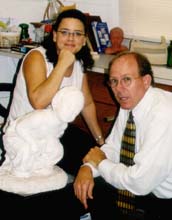
and then we sign the contract
Sculptor Bridgette Mongeon has documented the entire process of creating a figurine of a newsboy and a life-size bronze sculpture. Watch the artist work through these posts. In this blog, she has also included information for students and teachers. In the previous post, we learned how I pick a pose.
If you are lost and want to go back to the chronological running list of posts, follow this link.
Getting Ready for the Meeting
The photos are in the album, the contract is ready, and I have picked up the studio enough to be able to walk around without getting clay stuck to your shoes. I am ready for my meeting with the committee members from the Texas Press.
Visiting the Studio
Mr. Hodges and Ms. Garner Cash spent some time at the studio looking around and then we used the opportunity to shoot some photos. I explained the bronze process by showing them Ellie, a sculpture of a little girl. The first bronze was placed at the cemetery on Washington Avenue in Houston, Texas. The second one is intended for St. Mark’s United Methodist Church in Houston, Texas. After sculpting Ellie, a mold was made of her and then a wax poured in that mold. The wax is hollow and the same thickness that the bronze will be. This ‘lost wax method’ is one that we will be recording here with the sculpture of the newsboy. Oftentimes the sculpture is cut into different pieces to facilitate the foundry process.
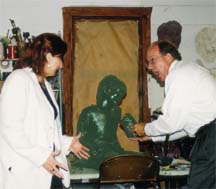
Did he Break it?
Yes, it looks like Mr. Hodges broke Ellie, but real, she is all right.
Lunch and a Review of the Pose!
After the studio, we proceeded to my favorite neighborhood restaurant, Peco’s, to discuss the schedule, the contract, and most importantly to look at the photos of Dusty. Each of us had our favorite photos and we all raised our hands at different times emulating the pose and the raising of the newspaper trying to get a feel for it. In fact we did it so often I think the waitresses, thinking that we were calling them, began to ignore us entirely.
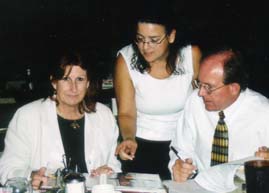
And the Finalist is…
While everyone was eating I pulled all of the photos that were finalists together onto one page. There were about 5. After a careful look at those, it was unanimous. With a little modification to the feet of one pose, we had our newsboy!
“Meeting you, visiting your studio, seeing examples of your artistry heightened my excitement about working with you on this project. It was solid affirmation that TPA made the right choice of a sculptor for our anniversary project. Bridgette’s style perfectly captures the innocence and vitality we hope to portray with our ‘newsboy’ statue.”
Wanda Garner Cash,
President, Texas Press Association
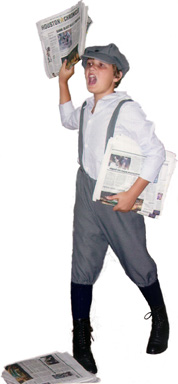
STUDENTS AND TEACHERS
Art and History
The lost wax method of sculpting is very old. We will get to see the documentation of the lost wax method of casting with the newsboy sculpture, however you can read a little more about it under the sculpture process link at the top of this page. There is a bit of information about the history of lost wax on other web sites as well. Following this link will lead you to an animated guide to bronze casting.
Later you will see that as the work progresses, chemistry will also become a part of the artistic process.
Vocabulary
A person who works in the lost wax method and in metal is called a metallurgist.
Let’s move onto the next steps in this process- Beginning the Small Sculpture.
Newsboy-How I Pick A Pose

poses for Dusty
Sculptor Bridgette Mongeon has documented the entire process of creating a figurine of a newsboy and a life-size bronze sculpture. Watch the artist work through these posts. In this blog, she has also included information for students and teachers. In the previous post, we learned a little about the beginning of this project.
If you are lost and want to go back to the chronological running list of posts, follow this link.
I keep thinking about the boys that I have read about. Barney Flaherty, the first paperboy hired by the New York Sun in 1833. That anniversary is coming up September 4th. I never knew that until I started this project. Though Dustin is the name of the boy that I have found for the first preliminary photo shoot, I wonder who I am sculpting? Is it Little Joe, Johnny Waffles, Skinny, Mickey, or any of the other children recounted in Death of a Newsboy? I will be thinking of them all, their entrepreneurial ability, tenacity, their struggle, and their place in history.
The photo sitting was so much fun!
I was able to find a newsboy outfit at a local costume company. It is not exactly what I want. The suspenders are wrong. I’d prefer the old leather ones that button to two buttons in the front. I also don’t like that the sleeves won’t roll up. But what do I want from a costume company? This one will do for this preliminary photo shoot. After all, what I am looking for is a pose. The costume is good enough not to cause distractions when trying to pick a pose. Later I’ll modify this costume, sew my own or find authentic clothing. But I want to have this sitting done before our Thursday meeting so that those attending the meeting can help me narrow down a pose.
I was elated when I first laid eyes on the model, Dustin Lee, in his costume. Dustin is the son of a friend of mine. I have known him since he was born but have not kept up with the family. I thought he would be around 11 years of age. When the Texas Press Association contacted me and said they would like an 11-year-old boy, I drove to my friend’s home to see if his mother would be interested.
Dustin or Dusty, as I have known him all his life, was a natural. His mom, a professional photographer, had groomed him well in the concept of modeling sessions. He was also quite animated. “EXTRA, EXTRA, READ ALL ABOUT IT!” he yelled as we tried pose after pose, paper in the air, holding papers, walking, and pointing. Prior to our sitting, I explained to him the importance of a newsboy and some of the history. I thought it might help him get into his part. “Your mouth is closing too quickly” I stated, “Can you hold the A in extra like your singing? Dusty bellowed “EXTRAAAAAAAAA” as I snapped the camera. When I felt we had exhausted all possibilities, our photo session ended. The outfit went back to the costume rental, and I waited anxiously for the photos to be developed.
September 1, 2004
The photos are back, and as I am looking at them, I am searching for movement, action, something to tell a story. Though I was unsure of the pose when the feet were so far a part, I am beginning to see a hidden meaning behind it-stability, being grounded, which represents the newspaper industry in itself. I am looking at those poses differently. The ones with the twist add motion; some, where the back is arched, add a different movement. I put all the photos in a resources photo album and mark my favorites with post-its, then I hand the photo album to my an artist friend, to get his opinion.
Meanwhile, seeing Dusty, in the outfit looking at the photos and getting closer to a pose, stirs up my creativity. Now the anticipation of actually getting my hands in the clay and working on the piece is beginning to build inside me. I can even feel the little flutters in my chest as I think of it. It is a great feeling! Allowing it to ferment there is a good thing. This stage of the creative process is called saturation.
While speaking to Dusty’s mom I learn that Dusty’s grandfather is elated over the idea of the sculpture of the newsboy and Dusty’s participation. Dusty’s grandfather was a newsboy for many years. These little elements add to the personal excitement of the sculpture, to the fermenting.
Next week I sculpt. But before that, let’s look at the next post about The Meeting.
STUDENTS AND TEACHERS
Art and History
• Why did the newsboys scream, “Extra, Extra Read all About It!”
• The sculpture that I am creating is in honor of the Texas Press Association’s 125th anniversary. Can you think of some big events that happened in the last 125 years that would have been headlines in the newspapers that the newsboys carried? Here is a website that can help you- Digital History.
Newsboy Sculpture-The Beginning.
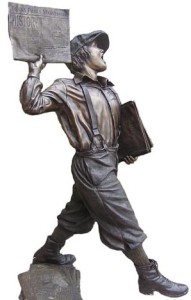
limited edition of 10. The
Newspaper that he holds
changes depending on
what headline the buyer
would like to see.
Sculptor Bridgette Mongeon has documented the entire process of creating a figurine of a newsboy and a life-size bronze sculpture. Watch the artist work through these posts. In this blog, she has also included information for students and teachers. In the previous post, we learned a little about the artists thoughts on the project.
If you are lost and want to go back to the chronological running list of posts, follow this link.
Thank you to the committee members of the Texas Press Association for choosing me as the artist for the newsboy sculpture that is intended for the state capitol. I am honored to participate in your 125th anniversary.
I was thrilled to be awarded the commission and have decided to document not only the artistic process but also the thought process of the entire work of art, an artist’s journal, so to speak. It is a way for the members of the Texas Press Association and others to witness the creative process and share in the personal thoughts of the artist.
I will try to update often, so please check back to see the progress.
I certainly welcome and appreciate newspaper coverage, as well as any other media coverage, and I will help anyone that is interested in getting the elements that they might need to create newsworthy stories. I would also appreciate your help in spreading the news about schools that are evaluating the Texas Press section of this web site as an educational tool.
Students and teachers
At the bottom of each page, you will find information to help you learn. There will be questions, further reading and items to spark your interest. Please feel free to e-mail me with your responses and I will post what I can. Thanks for your involvement.
Bridgette Mongeon
First Paperboy, Sept. 4, 1833:
Newspaper Carrier Day on Sept. 4 marks the anniversary of the hiring of the first paperboy in the United States. In 1833, The New York Sun ran the following ad: “To the Unemployed – – A number of steady men can find employment by vending this paper. A liberal discount is allowed to those who buy to sell again.” Ten-year-old Barney Flaherty, although not a man, was the first to answer the ad.
The small newsboy sculpture is available as a limited edition bronze.
Let’s go to the next page in this chronological order of the creating of a Newsboy Sculpture- How I Pick A Pose.
Newsboy- Thoughts on The Project
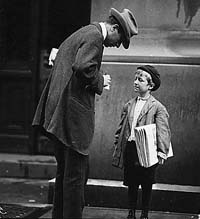
selling papers on the street.
Sculptor Bridgette Mongeon has documented the entire process of creating a figurine of a newsboy and a life-size bronze sculpture. Watch the artist work through these posts. In this blog, she has also included information for students and teachers. In the previous post, we learned a little about the history of the artist and newspapers.
If you are lost in the chronological order and want to go back to the running list of posts, follow this link.
I woke up early with newsboy on my brain. So, I thought I would do some research on them. I googled newsboy to see what came up. As I find information about newsboys I will add it to the Newsboy Links page.
Before I even begin the sculpture I can feel the passion for this piece stirring in me. These newsboys were the delivery system for news. At this time period there was no other form of delivery. I am always thrilled when I find young people who make a difference in the world. Maybe that is why I have such a desire to help youth. They can realize their potential, and, in turn, make a difference.
These young entrepreneurs made a huge difference. In the beginning, they were the only way for news to get to the public. As I google and read about things people wrote about them, I stumbled on the topic of Thomas Edison as a newsboy. He sold papers on the train as a youth. “Certainly,” I thought, “there were probably many famous people who started out as newsboys.”
I couldn’t help but imagine what it was like to be a newsboy. Yes there were newsgirls, a little unknown item of history. Newsboys needed to sell the paper, but how tempting it would be to want to keep one to read. In some cases I am sure the paper was the only source of reading material for these youth, if they could read.
THE POSE
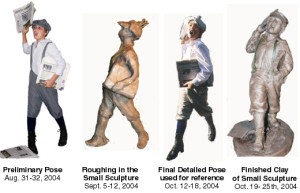
I am waiting on a phone call from someone who has an 11 year old boy, and am hoping that he fits my image of what I think this sculpture should look like. I think I might be able to get my hands on some period clothing, though I am wondering how difficult it will be to find shoes. My plan is to set up a photo shoot to try some different ideas for the sculpture. I’m hoping, by doing this photo shoot, that I can finalize some different poses and present these photos on Thursday Sept 2, when I meet with members of the committee. Once we decide on a pose I’ll set up another photo shoot focusing on that one pose alone, taking many rolls of film. This reference will be necessary to focus on the details.
Sunday August 29, 2004
I Googled once again! This time for photos of newsboys. I came up with several different items that I will put in a reference book to refer to while sculpting. I especially love the old photos, but there is nothing new about my loving old photos, I could spend hours looking at old photos. In fact I love the research on a project just as much as I love doing the project. It is also what I love about writing.
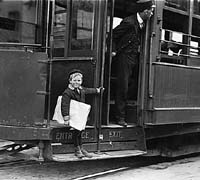
Because this sculpture is a part of history it makes it all the more fascinating for me. Though I will count on the photos from my own photo shoot, these stories and the images inspire me. If I look very closely I can look into the eyes of real children!
August 30, 2004
While pulling together the contract, I stopped at TITLE. I filled in Newsboy but I know that all sculptures tend to find their names as they progress. As I work, I will await those whispers that tell me the secret of what it should be called.
I am continuing to read the stories and history of the newsboys that I find on the Internet. I first struggled about reading Death of a Newsboy, but the massive amounts of information that was in this article written by Vincent DeGirolamo, in the Journal of Social History, is amazing. It has drawn me closer to the meaning behind the newsboys as a whole and this special boy. It will directly affect the personality of the sculpture and its spirit. Maybe this element is something that only I see or feel, or maybe it is part of what others notice and comment on when I hear them say, “Your work is so life like, or it has so much personality, or the faces, there is just something about the faces.”
I wish I had time to research some of the articles mentioned in Death of a Newsboy. I always like to saturate myself with the subject as much as possible.|
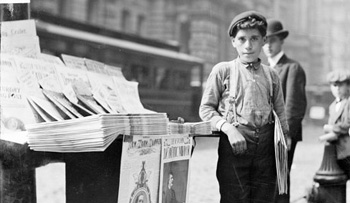
I have found a period costume for the photo shoot. Although there are some things about the outfit that I don’t like, I can change these things in the sculpture. Taking these preliminary photos will help me to define a pose. It enables me to look at alternatives that I have not seen and to notice the sculpture pose from other directions. I have found other sculptures of newsboys on the Internet. I certainly don’t want to copy them. I am waiting for this sculpture to unfold itself, though I know that ultimately the scene will come alive within the clay.
STUDENTS AND TEACHERS
Art and History
• What is the difference between a newsboy and a newscarrier?
• Do you know anyone who was a newsboy or newscarrier?
• Which character in Death of a Newsboy is your favorite and why?
• In the article, A History of Newboys in America the Spanish-American war affected the newsboys. How did it affect the newsboys in a positive way, and what affect did the end of the war have on the newsboys?
Let’s go to the next page in this chronological order of the creating of a Newsboy Sculpture and to The Beginning.
The above photos
The top two are by Hines and were found at:
http://web.mala.bc.ca/davies/H132/Hine.newsboy.street.photo.jpg
http://web.mala.bc.ca/davies/H132/Hine.newsboy.streetcar.photo.jpg
http://www.ita.doc.gov/td/oetca/cra2_files/newsboy.jpg
Newsboy-The News

for the Houston Chronicle
Sculptor Bridgette Mongeon has documented the entire process of creating both a figurine of a newsboy and a life-size bronze sculpture. Watch the artist work, through these posts. In this blog she has also included information for students and teachers. In the previous post we learned a little of history of the artist and newspapers.
If you are lost and want to go back to the running list of posts, simply follow this link.
August 26, 2004- The News
The committee met today and Mr. Hodges called me with the good news. I was flattered when he told me what he said to the committee. I believe he said something like…
“There is no doubt that all of the artists that we are looking at are more than qualified to do this sculpture, but if you are looking for a sculptor who has a passion for children then I think you will be pleased with Bridgette Mongeon.”
Passion for Children
Mr. Hodges is correct. I do have a passion, not only for sculpting children but also helping children. I work regularly with organizations like I Have a Dream, who help children with their education and I was thrilled to donate their Dream Maker Award.
I have made it a practice to find one organization a year for which I donate a sculpture . My stipulation is that they work with children, the hungry or poor. That does indeed cover a wide gambit. When I create these sculptures, I give them to the organizations to do whatever they would like. They can produce them for awards or sell them to raise money. (I donate the sculpting and turn the award recipient over to my manufacturer for mold making and manufacturing.) Donating these awards is my way of giving back.
My involvement with children does not end with I Have a Dream. I also have a ministry that I am working with in South Africa. Through this ministry I find school sponsors as well as garden sponsors for the poor children in the squatter’s camps in South Africa.
Years ago I developed a program called Express Yourself that I brought into inner city schools to help children express their emotions through the arts.
Not all my work is of children. This is my second sculpture this year related to the newspaper industry. In the beginning of the year I was contracted by the Houston Chronicle to create their Jesse Award.
I’m looking forward to working with the Texas Press Association and sharing my creative inspiration in this great celebration.
STUDENTS AND TEACHERS
Art and History
• Can you name other artists from the past who sculpted children?
• What was special about the children that they sculpted?
• In the information above you can see a sculpture called the Jesse. Do you know who Jesse Jones was? Why was he so important to Houston and Texas?
Geography
• In the above page it mentions that I work with children in Africa. Look on a map can you find the area of Africa where I work?
You have a bit of history here. Now, let’s look at the next blog post on this journey of creating a newsboy. Here are some thoughts on the project.
A Life Remembered Helps Six Children Go Mad Over Art
Tribune July 2003
Bridgette Mongeon © 2003
The excitement on the children’s faces at the Mad Hatters Art Camp was enough to inspire any writer. The enthusiasm of the six special participants was especially delightful.
Nicholas Orozco, Chelsea Valles, Daniel Duron, Ever Reyes, Faith Pruneda, and Rosa Juarez, were all winners of the Ellen O’Neal Art Scholarship.
Each child, encouraged by Harvard Elementary’s art teacher Mr. Robertson, submitted art work in hopes of winning the competition, and the award of the $300 tuition for the two weeks at The Mad Hatters Arts Camp.
The Ellen O’Neal Art Scholarship was developed by Jazzercize instructor Jane Luco and attorney Beatrice Mladenka-Fowler. Both women are friends of Jo Ellen Snow the mother of Ellen O’ Neal. Ellen O Neal was a vivacious artist who attended kindergarten and first grade at Harvard Elementary. She was also a student of artist Naomi Smulian, an art teacher at Mad Hatters Art Camp, and one of the camps founders.
Ellen never did get the opportunity to attend Mad Hatters Art Camp; she lost her battle with a brain cancer while attending Harvard Elementary. Both Luco and Mladenka-Fowler felt it was important to contribute to Ellen’s memory and created the Ellen O’Neal Art Scholarship. Teachers at Harvard Elementary determine who is eligible. The scholarship is based on financial need, artistic talent, good citizenship and a commitment from the parents concerning transportation.
“I’m very, very proud,” states Snow, “I greatly appreciate anything that keeps Ellie’s memory alive, both at Harvard Elementary and in the community.”
This is the third year that the scholarships have been awarded. The first year two scholarships were awarded. The second year the scholarships grew to one child in each age category, kindergarten through fifth grade. Luco and Mladenk-Fowler raise the funds for the scholarship yearly. Luco said her dream would be to send a boy and girl in each grade, funds permitting.
I had a chance to visit the camp and talk to some of the scholarship winners. I was greatly impressed with the quality of the camp and the teachers. They were all professionals in their field, giving the highest quality of instruction. This year’s theme of Around the World with the Mad Hatter also added geography and further education into the mix. The children were each equipped with their passports that were stamped as they traveled with their instructors to such far away places as Barbados, China, Greece and Portugal.
I met with one of the winners, Daniel Duron, in art teacher Cindy De Hart’s class. Daniel was in the Australian room busily working on a paper sculpture while fiddling with his colorful smock. Daniel said the camp was pretty good “you get to go outside and play and I do art and rhythm and music and the drums.” His eyes twinkled as he said drums. I asked him if he knew who Ellen O’Neal was and how he felt about the scholarship “I felt happy when I won, Ellie was a girl who died and loved to paint. She was a great artist. I want to be a great artist like her too.”
I met with Ever Reyes in Greece at the theater class held by Robb Brunson. Ever was a bit older than Daniel and seemed to know why this scholarship came to be. “The girl’s favorite thing was drawing and they did this to remind everyone of her.” Ever was also very expressive when describing his work. “I worked on the art picture all day, I added wallpaper and colored with crayons and then I thought about doing something with dinosaurs, so I made them stripes, then the night sky not really a night sky” I could tell he was really into this painting.
I stopped into two other classes before the last, Rhythm and Movement with Kristie Kiser and Nature Studies by David Petersen. As I talked with each teacher I was impressed with their ability to woo the children into creativity and learning. “It is as much about team work, and critical thinking as it is movement. We are teaching the kids thinking skills, how to be choreographers”, states Kiser. In Mr. Peterson’s class I was enlightened to hear a run down of what they did that day, as the children lined up at the door and handed in their colored paper chameleons. “We looked for grasshoppers to feed the fire belly toad, we looked at the baby caterpillars, and also talked about how our nose has a memory, and that my favorite smell was dill because it reminded me of my grandmothers farm. We also got to look at the butterfly wing under the microscope and name our snails.” I was beginning to wish I had arrived in this class a bit early to take part in some of the adventure and quickly ran to look at the butterfly before running to my next class.
The last class I visited was Terrence Karn’s music room. I arrived before the children and marveled at the 18+ drums lined up in front of chairs, along with two plastic waterbottles, a Rubbermaid container and plastic planters each with their own set of drum sticks. The children didn’t miss a beat in Mr. Karn’s class. I could see why Daniel’s eyes twinkled when talking about Mr. Karn and the drums. Scholarship winner, Chelsea Valles, was enjoying the opportunity of echoing the teacher’s rhythm on a drum.
Even though I did not get to visit all the classes nor meet all the winners, when I left Mad Hatters I felt like I had been on an adventure, and I had only been there a few hours. It must be wonderful to be a kid and have two weeks of this creative experience. For all the participants I am sure it would be a memory that would last a lifetime, and for six special children a life of a little girl that would be remembered.
The Ellen O’Neal Art Scholarship is maintained by the Houston Independent School District. To make a donation please send a check made payable to HISD, and mail to Snow and Whitworth, Attorneys at Law, 1148 Heights Blvd, Houston, Texas 77008.
To receive information about next years Mad Hatters Art Camp contact Claire Smith administrator at 832-618-1120.
All written work is copyrighted and cannot be used, whole or impart,
without the written consent of the author.
Heights Artist Helps Children With Cancer Through Artwork
Houston Tribune December 2002
Bridgette Mongeon © 2002
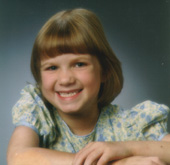
I first heard about Ellie’s artwork from her sister Meagan. One day while driving Meagan home from church, I was discussing the production process of my own sculptures that were packed neatly in a box on the floorboard of my van. “I am familiar with sculpting,” Meagan replied, “My sister’s an artist”. I was intrigued, wondering about her sister’s art. Moments later I was in Meagan’s home and viewing that very artwork. Watercolors were framed and hung with honor in the hallway of their home; colorful animal figurines were corralled on end tables. Stain glass art hung in the window, while reproductions of Ellie’s art sat upon the dining room table. Soon Ellie’s mom, Jo Ellen Snow, and I were enthralled in a conversation about Ellie’s art.
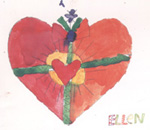
Ellie’s painting titled, “Gift Heart” was first reproduced as gift cards. She felt honored to have her artwork chosen by the MD Anderson Children’s Art Project. A reproduction of an artist’s artwork at any age is quite an accomplishment. It is a tremendous honor when you are only 7 years old. Ellie received a two hundred-dollar honorarium and recognition for her efforts, however, she never would have the opportunity to see the effects and demand that her artwork created. Within a few days of viewing the printed note cards Ellie O’ Neal lost her ferocious fight with a brain tumor that held so tightly to her little body. On January 17, 2001 Ellie passed away. The Children’s Art Project worked diligently to reproduce the jewelry created from Ellie’s art so that family members at Ellie’s funeral could wear it proudly.
Since Ellie’s death, many Height’s residents have honored her. Orange ribbons appeared throughout the Heights. Ellie’s Elm is planted in Donovan Park, in the very spot that she held her third year birthday party, the first birthday party to be held in the then newly built park. Harvard Elementary has a Japanese maple, a bench with painted tiles from her classmates, and a courtyard dedicated in her memory. The street median of Heights Boulevard has a sweet gum tree planted by the Houston Heights Association that was donated by the law firm of Snow and Whitworth, Ellie’s mom’s law firm. “I can see the tree from my window,” states Ellie’s mom. When driving down Heights Boulevard one will notice the tree still has its orange ribbon.
Ellie studied for three years with artist Naomi Smulian at Arts Studio on the Boulevard. Naomi describes Ellie’s artwork as being very sensitive, “Ellie had a calculated sense of design. She loved color and had her favorites,” states Ms. Smulian.
Ellie’s watercolor, “Gift Heart” is now being produced as a Radko Christmas Ornament. Gayle Goodwin, communications director of the Children’s Art Project, states that the ornaments are flying off the shelves. There is discussion of reproducing yet another piece of Ellie’s art for the Children’s Art Project.
“Anytime you buy artwork from the Children’s Art Project, it is a gift that gives twice. All the proceeds from the artwork go to fund the children’s projects at MD Anderson, including the art program,” states Ms. Goodwin. In the 29 years of its existence 15 million dollars has been given back to the program. Ellie certainly has made her mark on the Heights, the art community, and the many children at MD Anderson. Ellie’s “Gift Heart” just keeps on giving.
If you would like to purchase any of Ellie’s artwork or any other artwork from the Children’s Art Program it can be seen at www.childrensart.org or ordered at 1 800-231-1580.
All written work is copyrighted and cannot be used, whole or impart,
without the written consent of the author.